Author: chris_eldon

  • Simplify

    Over the past year or so, I’ve been making an intentional effort to simplify things in my life. Not all of it has been successful, but as with most things in life, it’s a journey. There are ups and downs, but what matters is whether forward progress is being made to reach those goals.

    A lot of the things that I’ve been trying to simplify revolve around the way that I use tech. The key thing to keep in mind with all of this though is that – just like with most things in life – it’s a marathon, not a sprint. None of these things will change overnight, nor would I recommend it. The best way in my experience to effect change on oneself is to dip your toes in slowly and gradually. Just like with any habit, it takes commitment and intentional action over an extended period of time to adjust. We’re creatures of habit after all.

    A contradiction

    And while saying that…. I’m also part hypocrite. One of the things that I am working on changing is using vim for more text editing and less bespoke code editors. I made a switch from VS Code to vscodium a few weeks back and figured I would instead take the plunge into learning the inner workings of vim more. Especially after reading this post by Simon Späti, it really inspired me to give it a whirl. I’ve used it for basic things and know of *some* commands (like, saving, moving the cursor, and most importantly, exiting vim).

    To really get into the flow of it and force myself to learn it, I’m rewriting this entire website using vim exclusively. That might sound daunting to some but I’m enjoying the challenge and realizing that there are a LOT of cool features about vim.

    Simple is good

    As part of this website redesign, I’m also shifting away even further from some of the tools I was using previously. When I first wrote this website, I was using WordPress. There’s nothing wrong with it, it’s just a lot. It’s never been simpler to start a WordPress website though, and it’s only getting easier. The issue I had was it’s not as straightforward to migrate to different sites, it requires a lot of features to be installed, and self-hosting it can be a little bit of a pain – not in a difficult kind of way but more of an “ugh I really don’t want to do this” kind of way.

    So then I moved toward Hugo. Hugo is a Static Site Generator written in Go that allows you to write your content in Markdown and it converts everything into plain HTML and CSS, which can then be uploaded to any host in the world. This was cool to learn, and I really enjoyed working with it. I can’t place my finger on it, but I wanted something different.

    In going with the theme of simplifying, I’m now in the process of rewriting the site (while still using vim exclusively) using just your basic HTML and some minimal CSS. I don’t plan on incorporating JavaScript at all (this is a fairly vanilla blog at the end of the day). You’ll even notice I’m not even minifying content – if you see something you like or want to see the inner workings of the pages in your browser, go ahead and right-click and hit View Source. I’ll wait.

    But why do this

    A big part of this is to be intentional with tech, like I’ve said before. Here lately, I’ve had a feeling that nothing about tech nowadays is good enough. It always has to advance something.

    Data collection.

    Money.

    Squashing competitors.

    There always has to be something more. Nothing can ever just be. I used to be all-in on the internet-connected everything. I thought it was the coolest thing in the world. Then devices would go end-of-life and conveniently, the only way to restore that functionality would be to buy the new model.

    The same can be seen with the yearly release and upgrade pushing that smartphone manufacturers do, at least as an example. There’s nothing inherently wrong with the annual release cycle per-se. The issue I take with it is the promotion of constantly trading in your old device to get a new one. I fell into this trap before. I’d see the new shiny, would want the new shiny, and would buy the new shiny and discard the old one. Especially with the advancements in hardware today, most year-to-year changes are minimal at best.

    I also REALLY don’t like the constant push for more and more AI tech in my phones.

    So to the why. Really, it just has to do with my general feeling of losing interest in tech. Getting back in touch with the physical world has been wonderful. I’ve been enjoying my walks outdoors more (at least, when it’s not a million degrees outside), I’ve been finding much more joy in reading physical books over my Kindle, and writing with a pen and paper has been wonderful, even for things as simple as jotting something down quickly in a meeting. I still use tech*, I’m just more intentional about it now.

    * I stay away from using AI for the most part. Sure, it probably has its uses and I’ll probably get left behind eventually, but I have no qualms not using it.

    You went and rambled again, Chris

    Yeah I’m good at that. This turned out a little differently than I had in my head (and also compared to my first draft….. which was in vim….. which I lost lol). I’ve got a lot of work to do to really get things down to more simpler terms. I could write all sorts of posts (and probably will) chronically my journey on this. For example, I’m trying to get back on good terms with cooking (recent months has seen that failing but the attempt is what matters), and in doing so, getting to better foods and overall kitchen utensils that will better serve me in the long run. There’s a whole subject matter on this topic that I can get into, but I’ll save that for another time.


  • Relaxing

    Things are hectic in the world. Make sure you find some time to unwind doing something you love. I’ve had a pretty rough start to the year so far myself. I won’t go into what’s been going on here, but suffice to say, I really hope I’m on the upswing. I think so, but we’ll see.

    I just wanted to take a moment to point out that it’s important to find some time to relax a bit. I’ve been slowly finding myself gravitating away from devices and more to physical things. I’m starting to prefer taking physical notes over reaching for my phone first, reading physical books versus ebooks, and just enjoying working on things that I can see and feel. None of this is to say I plan on getting out of the tech field, but I do think that I need to expand my hobbies out from solely online things.

    Lately, there are two main things that I do to unwind. Those are lifting weights and doing yard work. I’ve even got to wearing the “dad shoes” that all of our dads would wear when mowing the grass – no lie, they’re super comfy.

    Weight lifting has been a huge boost for me. I’m still only a couple months into it again, but there’s something cathartic about being able to shut off the outside world, kick on some heavy jams, and focus on performing the movements with proper form. I still have a ways to go before I get back to my previous lifting numbers, but I’m not in any rush. The important thing is paying attention to what my body is telling me.

    Yard work is another one of those things that just has to get done. It doesn’t always have to be seen as a chore though. It’s a tough mindset to get out of though. I used to hate doing it, but when I started looking at the bigger picture, I found that I enjoyed the process more. I don’t have the best looking yard in the neighborhood, nor do I want to. I want it to look good for us, to be a place where we can express ourselves. Don’t get me wrong, there are some parts of yard maintenance that I don’t like – trimming hedges and pulling weeds aren’t exactly my idea of fun – but it’s all part of the process. It’s another one of those things where if you let yourself get lost in the activity, you can actually find it to be quite peaceful and fulfilling. Watching something you worked on flourish over time can be exciting.

  • Finding Privacy

    After over 15 years of using Google for emails, documents, cloud storage, and a plethora of other services, it’s time for a change. It’s also a great time in general given the state of the world at the moment.

    It’s not you… no wait, yeah it is

    I’ve used Google services for well over 15 years, and honestly that’s likely still too short. From search, to cloud storage, to email, to even Google Plus (remember that thing?), I used to be a huge Google fanboy. If there was a new service, I had to use it. I’ve dabbled with using Google Analytics, I used to have AdSense on my YouTube account (yay for making a whole $1 with it), and even used Gemini when it first came out. I thought it was the best thing ever.

    As I’ve been online more and have been advancing further in my career, I’ve been taking a closer look at where my data is going and who is using it. Honestly, it’s absolutely shocking to see what level of detail Google has on you, even without using their services directly. The big tech oligarchy was already starting to show its true colors, but given recent… ahem… world events… it’s even more in-your-face now. I already deleted my Facebook account years ago, Twitter has been gone for awhile, and I never really did much with other social media platforms (Reddit notwithstanding, that’s another story). Google is the hard one though.

    A sign that says Privacy Please.
    Photo by Jason Dent on Unsplash

    How do you say goodbye after so long?

    Being so ingrained in Google services, it’s hard to just stop using all of it. I mean hell, I have a Google Pixel 8 Pro – without installing a new OS, that’s like a perfect window into my life.

    I’m not here to say “if you don’t do privacy 100% then don’t bother.” Quite the contrary. Going all-in right away is almost assuredly going to result in failure. Also, the all-or-nothing mindset is dumb, just read this amazing article from PrivacyGuides.org. Just because you don’t completely stop using a service doesn’t mean the value that you get from incrementally improving your privacy posture is worthless. One step at a time.

    Email is a good place to start

    The main thing I started with was email. This is also likely one of the hardest things, especially since email can be notoriously different to host. I’ve had experience with email server hosting for a number of years now, so I currently self-host my email but I understand that isn’t feasible for everyone. There are all sorts of options available though, from Proton, Tutanota, Mailbox.org, MXRoute, and so much more. I generally prefer mail providers that don’t lock you in to their own email clients – tried and true IMAP and SMTP protocols just work and make it trivial to migrate to a new provider with tools like imapsync.

    For my Android device, I used Fairemail, on my various desktops and laptops, I use Thunderbird. I also use an email masking service called addy.io (edit August 31, 2025: I’m now using Fastmail for both email hosting and address masking).

    This lets you create email masks that hide your real email address from services. This lets you do a few things:

    • Quickly turn on or off a mask to enable/disable email from that service
    • Tell if a service had a breach or sold your email if you start receiving email from a different service to an existing mask.
    • Enhance your privacy by not handing out your real email, especially if you use your name in your email address or domain.

    Where possible, I also use PGP keys to encrypt emails. This doesn’t always work as it relies on the receiver having their key published or pre-shared, which can be challenging. One thing I also try to do is use plain text emails. On the surface, this doesn’t seem like it would affect privacy, but HTML emails are rife with tracking images and other elements that give away if you’ve opened the email, track whether you’ve clicked on links, and more. A nice thing with Fairemail is it has options to prevent those things from rendering and tells you when an email has them, and can even strip the tracking parameters from links.

    What else can you do?

    USE AN AD BLOCKER.

    No seriously, if you don’t have one, get one. Also, try to get off of Chromium browsers if you can. Google Chrome has a huge marketshare at 66%, and their open-source Chromium project is the source for a whole slew of other browsers (think Edge, Opera, Vivaldi, Brave, and many more). Meanwhile, Firefox sits at around 2% according to the previous link.

    I personally use Librewolf where I can. Librewolf is a fork of Firefox that has more privacy-focused settings enabled by default, enhanced browser fingerprinting protection, and removes a lot of the baked-in telemetry that Firefox has. Otherwise, it works just like Firefox does – all of the extensions for Firefox that I use work (and try to minimize those as best as you can). I don’t use it on my work laptop as I try to use browsers that my customers use as often as possible to ensure we’re testing apples to apples.

    Install uBlock origin (not just uBlock, make sure it’s uBlock origin). On Chrome, there’s a uBlock Lite extension that’s available now that Manifest v2 is no longer allowed.

    Are there search alternatives?

    I’m glad you asked! A coworker recently shared a link to Kagi with me. Kagi is a subscription-based, privacy-first search provider. I was a little stumped at first as to why I would want to pay for searches online, but think about it – searches can be on all sorts of topics and can give a personal insight into you on things you might want to buy, things you may be researching for your health, relationship advice, the list goes on and on. Free search engines use this data to build a profile on you and target advertisements your way. Not Kagi. Kagi tries to filter out the noise and provide meaningful answers to queries and doesn’t just show the same 3 websites that won the quarterly SEO battle over and over again. They even have a Small Web initiative to try to build awareness for a more personal web again, which I think is wonderful.

    As I mentioned earlier, privacy is not an all-or-nothing mindset. Take incremental steps to reach your goals and know that along the way, you are slowly working to improve your overall privacy in the long run. I’m sure I’ll have more posts on this as I do more myself (I haven’t even touched on the topic of cloud storage and my self-hosting adventure), but that’s for another time.

    I’d love to hear about your efforts to improve your online privacy. What sort of tactics have you taken to regain your data agency? Shoot me an email (you can find it on my contact page)!

  • Weight Lifting

    Lifting weights is cathartic for me. It’s one of the things that let’s me completely stop focusing on everything else except the workout and be in the present.

    Getting Healthier

    This year I am striving to become healthier. Before COVID, I’d say sometime around 2017-2019, I was an avid lifter. I was generally working out 4 times a week using a program I found on the Fitness subreddit of all places. I think it was call the nSuns workout, but I don’t fully remember. Anyway, I loved it. During the workouts, it’s a time of intense focus – everything else has to get pushed away to focus on moving the weight. At peak, I never broke any records or anything, but I was pretty happy with where I was at. Here are some numbers for what I achieved through two and a half years of consistent workouts:

    ExerciseWeight
    Squats185 lbs
    Bench Press185 lbs
    Deadlift285 lbs
    Overhead Press90 lbs
    Barbell Rows140 lbs

    For context, I was 175 lbs and 6 feet tall at the time (well, I’m still 6 feet tall, but you know, definitely not the same weight).

    Photo of a barbell resting on the floor with weights on it.

    Why did I stop?

    One day while doing chest dips, I pulled a muscle in my chest. It took me out of commission for quite awhile and left me in a weird funk. You don’t realize how much you rely on your chest muscles until you try to do something as innocuous as pushing yourself out of a chair.

    My wife and I were also in the midst of buying our first house and preparing for a major move, so the added stress on that was eating away at my motivation. Even though lifting weights (or really any type of exercise) is great for your mood, I just didn’t want to do it.

    And then the world ended

    Well, not so much as ended, but close enough it feels like. The COVID-19 pandemic put me into a proper state of malais. I was not feeling it at all. I’m doing better now overall, still have ups and downs, but managing my mental health has definitely taken a proactive approach to ensure I don’t fall back down a few rungs in the ladder.

    Something that has been helping recently has been finding more personal sites to browse and see how other people are doing online. I’ve been making a conscious effort to stay away from the major social media platforms (and have long-since deleted the big ones, namely Facebook, Instagram, Twitter, and more). I still have a Reddit account but I’m trying to focus on my RSS feed over the Reddit feeds and it’s been surprisingly refreshing.

    None of that last paragraph is related to lifting, Chris

    Back on topic. For the last 4 weeks, I have been doing the Stronglifts 5×5 workout program. This is what I originally started with when I first dipped my toes into weight lifting. The primary program is a beginner-friendly plan that allows you to progressively increase the weight you are lifting. For folks that are rusty like I am, the first few workouts will be tough thanks to DOMS but once you get over the hurdle, you should start seeing those numbers soar up for a few weeks. At least until the beginner gains are depleted.

    My goal is not to break any records but rather general fitness and improving my overall health and mental wellbeing. The hardest part about the workouts is showing up – even a bad workout is better than not doing it at all. For now, my focus is on remaining consistent and steadily progress until I get back up to the figures that I initially posted. It’s going to take some time – it’s a marathon, not a sprint. I am committed to paying close attention to my overall form and listening to my body. If something feels weird, I’m going to pay attention.

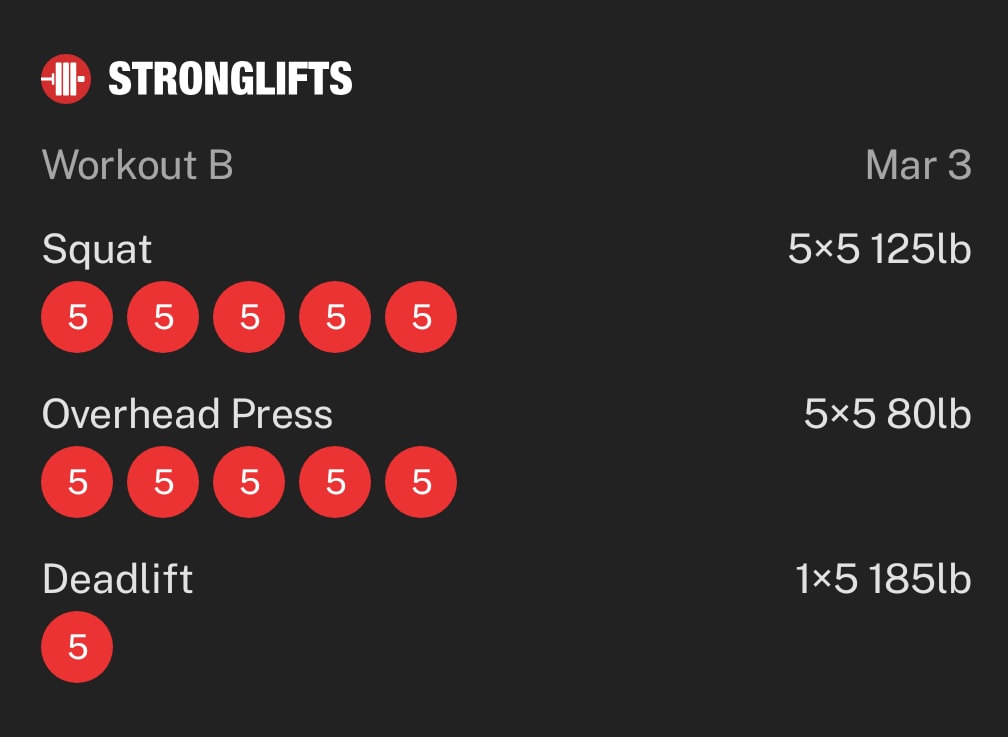
    For reference, here are the latest numbers from my most recent workout today:

    Screenshot of my workout summary from March 4, 2025 in the Stronglifts mobile app.

    I want to hear from you!

    What type of workouts do you do? Even something as simple as walks around the neighborhood are great ways to get the heart going. I’d love to hear what you do to stay active, feel free to send me an email (details in my contact page)!

  • Refinement

    What’s the old saying? Don’t let perfect be the enemy of good enough? Sometimes you gotta know when to deliver the MVP and when you can spare some time on the details.

    I’ve been working a lot on a Python library at work. It’s not intended to be released for public consumption, although I may be able to make a version that’s stripped of some of the internal pieces to share. The main idea behind the library is to basically allow my team members to quickly build in what I like to call the “plumbing code” to their own scripts.

    What do you mean “plumbing code?”

    I’m glad you asked! Basically, when I refer to plumbing code, I generally just mean the parts that are consistent across scripts. For reference, the library is essentially the typical Python Requests library, with some authentication components for our APIs, as well as internal rate limiting, error handling, and logging built-in. A common theme we see in our Architecture Review Boards are:

    • A lack of clear error handling
    • No logging at all, sometimes not even to the console
    • No consideration for the health of our APIs (which are used both internally and by customers 😮

    The main driver behind writing this library was honestly a selfish one. I am constantly asked how we can make calls to our APIs, what are the best ways to interface with them, how do we parse the data, or submit data, etc etc. My goal was to build a tool that gives my coworkers a straightforward way to get past the building block and instead focus on the parts they care about – the business logic, the meat behind the script that actually does the job they want.

    What does refinement have to do here?

    I’m still relatively new to Python, even though I’ve been working with it for a number of years now. I’m even newer to Object-Oriented Programming. I’m still coming to grips with that whole paradigm shift but it’s made certain things a lot easier to work with now that it’s starting to click.

    I bring up refinement here because I like to take an iterative approach to building scripts. I generally have a defined goal in mind, but I try to build up a Minimum Viable Product first that I can demo. This is important for a few reasons, namely:

    • It let’s me see if there is interest quickly
    • I can quickly shift gears to alternate approaches without having wasted a ton of time

    There’s also something to be said about seeing progress by releasing bite-sized versions of this library for use internally too. The feedback I’ve been receiving so far has been excellent. I’m hoping to be able to release it company-wide in the near future, just have a few more things I’d like to refine on it, mostly around error handling.

    What else can refining be part of in development?

    I’d also consider the expanded learning opportunities that I’ve had with this sort of tooling to be very beneficial. When I first started this project, I had some ideas about how I would accomplish them but as I got moving further, it became clear that there were other, better ways that I never knew about. I’m still learning more but the idea is fairly simple – I don’t know what I don’t know, and I won’t know until I do know.

    That sounds super cheesy, what the heck.

    But anyway, I think it makes sense. The only way to really understand a new tool or feature or language, or anything really, is to dive in and give it a try. Who knows what you’ll find out! It’s a constant game of refining your existing knowledge with the newly minted shiny snippets and see what works together and what doesn’t. It’s also given me a chance to look back on other things that I’ve written to see how I can do better. For example, one of the features I really wanted with this library was a way to tell the user “hey, you should really do a git pull here, there’s an update.” Well, I was able to build a very basic feature in that calls a hostname I manage internally that maintains a version status of my scripts. Every time one of the scripts runs, it makes a super lightweight call to this endpoint and compares its own version number in the code with the result from the query and if it doesn’t match, it informs the user of the pending changes.

    I’m here for learning about anything. I love digging into how things work – technical manuals are some great treasure troves of information and generally provide you with more insight into the language than any tutorial will, but only if you are willing to put forth the effort.

    When I get some spare time, I’ll work on parsing out the internal pieces of the library and see if I can do a deeper dive on it in a post here. I think it would be cool – I know it likely won’t be a super revolutionary thing but if it helps one person, I’d call it a win.

    What sort of refinement do you have going on your life? Could be anything, personal, professional, silly. I’d love to hear about it!

  • You Matter

    While we deal with the whirlwind that is life, the current political climate, ever-increasing world tensions, and just generally trying to stay alive, remember this.

    You matter.

    Life can be hard. I’m certainly going through some tough time at the moment. It’s ok to recognize it for what it is. It sucks.

    A person giving a paper heart to someone else.
    Photo by Kelly Sikkema on Unsplash

    I’ve talked about the struggled with imposter syndrome that I deal with. Even being in my field for 15 years, it’s still easy to feel like my peers are all smarter than me. Hell, even starting this blog was daunting. There are so many incredible sites out there, it’s a little hard to dip my toes in. Nothing that I’m going to put here is groundbreaking – I don’t have any public Github projects, I don’t have a ton of development experience.

    What I do have, though, is the desire to learn and push forward. Even in dark times, try to make just a little bit of progress. Anything moving forward is a step in the right direction, even if it’s hard.

    This post by Manu resonated with me so much. I feel just about everything in that post to my core. I have to keep telling myself that just because I may not be the best at any particular thing, that my opinion and experience still matters.

    This blog of mine is a first step in that direction I’m taking. I’m still learning a ton, and I’m sure things will change as I figure out more of what I want this to be. It’s all part of the experience.

  • In defense of Text Guides

    Text-based guides are just easier to follow along. Video is great in short bursts. When you’re heads down learning something new though, I find text guides to be far superior.

    Wait, you what now?

    YouTube is a great site, don’t get me wrong (except for, you know, the Google of it all). There’s endless piles of content available at your fingertips (both good and bad. Ok, mostly bad). Want to learn about a new programming language? Need a refresher on accounting? Want to actually figure out what underwater basket weaving is all about? You got it!

    But you know what? How am I supposed to do the thing that I’m learning how to do if I’m focused on finding the right spot in the video? The 30 second “this is the thing, this is how do it, the end” videos are the exception here (not that many of those really exist – thanks SEO).

    I find it far easier to read through a service manual, technical documentation, or even just a forum post with community-source discussions around a problem. You can search for keywords directly in your browser, bookmark the page, copy the text down to your own devices, hell, even break out the ol’ printer (you do have ink, right?) and make a hard copy.

    It gives us time to chew on it, go at our own pace, and get the content that we need. A 40 minute tutorial on something that takes less than 10 minutes to complete if you know all of the steps just seems like a waste of time if you ask me.

    But isn’t video all the rage now?

    Yeah, it sure is. SEO, advertising, sponsors. All of those are a dime a dozen now with videos. Much like the small web, good luck finding the niche videos in your searches. Thanks to the popularity of monetizing our hobbies, every video we tend to see now is generally 15 minutes or longer. And since you can’t search through videos, good luck finding the thing you needed quickly. Hopefully the video you just clicked on has chapters bookmarked in the description for you to skip to.

    So yeah, to all those tech writers, you’re doing great work and just know that we appreciate you. It’s not easy work (let me tell you how much I love writing documentation). But it’s absolutely essential to being able to easily digest information on our time, not at the advertisers time.

    What are your thoughts on this? Feel free to hit me up about it in my email on my Contact page.

  • Imposter Syndrome

    I’ve been in tech for over 15 years. Since I started, I’ve been dealing with imposter syndrome. I’ve been working through it with various strategies. This is mostly just a vent.

    Dealing with Imposter Syndrome

    I started working in tech as an intern at 15 years old for my local school district. It was mostly helping them go through e-waste from schools for recycling during the summer. It progressed to helping with new build outs for computer labs and delivering components to on-site technicians as the schools. I did this until graduated high school (but only during the summers, my school time was all tied up thanks to the IB program).

    I think started at the University of Central Florida with an Information Technology major. Everyone felt like they knew so much more than me and asked a lot of smart questions. I felt totally out of my element.

    Then I was recommended for a teaching assistance position for a programming course. This was unexpected, as I was personally struggling with the course work that I was supposed to be helping others with, but I made it work.

    I only this for a year until I got a job at a local web hosting company as a Level 1 helpdesk tech. Mostly just handled calls from customers about issues with their websites. I quickly moved up to Level 2, and then on to the coveted Level 3 role (this one was nice because you got to be in a desk away from the noise of the main helpdesk area to focus on your tickets, as well as not having a phone on your desk).

    Moving from a job to a career

    I graduated from the University of Central Florida in 2014 (oof it’s been 10 years now since this was written). While I was wrapping up final exams, I interviewed for a bunch of different places, but finally landed the opportunity I have now. The interview process went well, although I was nervous all throughout wondering if I knew enough. Based on some of the previous interviews I had, I was definitely feeling down on myself with how the interviewers were reacting.

    Before I could even get to the airport to head back home that night, I had a phone call with the job offer.

    I was ecstatic, nervous, and ready to move forward all at the same time. A few weeks later, once graduation was complete, I moved on up to Maryland and started the job.

    Boy did I feel out of place again.

    Being the newbie

    For the longest time, I was the youngest person on the team. I joined the company was I was 24 years old and at the time, they pretty much never hired people right out of college. I had a lot to prove to my coworkers and quickly finished training and got put onto some pretty heavy accounts. Things were going pretty well, I was starting to get used to working with my new coworkers, settling into the account work.

    About a year in – and pretty much ever since – I’ve been hit with a heavy dose of imposter syndrome. I’ve been working through it by keeping notes of what I’ve accomplished throughout the year, notes of affirmation from customers and coworkers alike, and keeping track of what tasks I’m working on and what I’ve completed. I still feel like I’m waiting on the shoe to drop all the time though.

    I get anxious about important changes. I get anxious about things that won’t make any impact at all. I feel like I have to double- or triple-check my work before handing it off. It’s a big weight that I feel like I carry for no reason. I started working here as a Solutions Architect at the bottom of the ladder – today I’m a Senior Solutions Architect II and the third most-tenured person on the team. I’ve received countless rewards and recognition for the work that I’ve put in to make my customers and team successful.

    Why do I feel this way?

    I’ve always been a people pleaser. I take on way too much work compared to what I can actually complete in a reasonable time. Somehow I make it work. There were a few years where I legitimately considered quitting and finding a new job because of the stress and burnout I was feeling.

    I’m still working a lot on saying no to work that I don’t have adequate time to take on. If fire drills pop up on my accounts, I’ll take care of them. Typical day-to-day work though? If I don’t have the time, it’s gotta go elsewhere or get pushed to the end of the line.

    I used to just say yes to everything, get overwhelmed, get into a cramming mode, and then suffer the consequences later. Things have gotten better, but it’s taken effort of saying no. Management has also helped a lot in the past 5 or 6 years as there has been a really strong push in improving our work-life balance, which has been great to see.

    Where do we go from here?

    I’m still working on myself – that’s probably a lifelong journey to be honest. If I start to feel stressed, I set my work messenger status to Do Not Disturb, shut down my email client, and focus on a single project for an hour or so. This helps to keep distractions away and gives me time to get things done that have been sitting.

    I also still have to improve my own internalized thinking of myself. I’m wanting to get back into lifting weights again. The handful of years where I was consistently lifting weights four times a week and eating a healthy diet is about where I felt the best about myself. I felt strong, like I could take on anything.

    I need to get back to that feeling.

  • Renewing My Blog

    It’s been a long time since I’ve written a proper blog post. Well, I don’t even know what a ‘proper’ blog post is at this point.

    A long time coming

    Is a proper blog post something that is written consistently? Does it need a defined topic? I don’t know, but that’s something for another day.

    What matters is actually writing something. I don’t really plan on having a proper schedule for this, and honestly I don’t even know if anyone is going to read this (nor will I know, since I’m not keeping track of any analytics). This is really a place for me to just put my thoughts down. If I have something fun to share, maybe I’ll share it here too. In either case, expect to see a not-so-frequent-but-maybe-frequent stream of updates. No promises on quality of content either.

    In the past, I would use this as a place for tracking my workouts and talking about some nutrition items that I’ve been working on. That’s something that I would really liked to get back to. I need to start making my health a priority as I’ve been putting it off for too long. I’m still young, but won’t get any younger so the most I can do now, the better off I’ll be in the future.

    Anyway, here’s a picture of a cat for fun.

    Photo of a cat with its tongue sticking out.
  • PHP

    PHP is a cool language